 CRATE
CRATE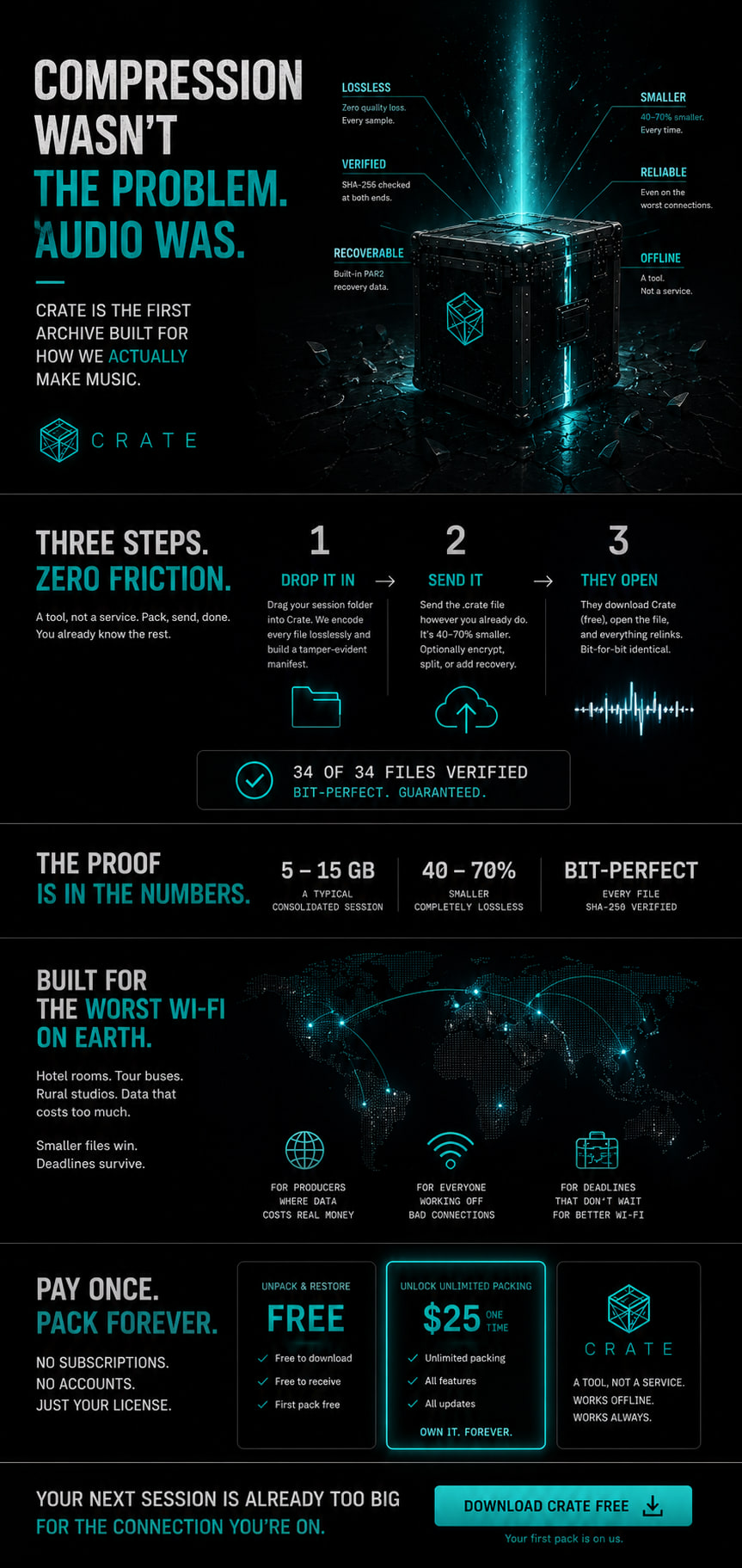
The first time someone tells you to "just zip the session," they have already lost. You zip a 12 gigabyte session folder and it comes out at 11.6 gigabytes, and you sit there wondering what the point was. I did this for years before I understood why.
The point is that zip was never built for audio. It is a general purpose compressor, and your session is mostly already as random as the algorithm knows how to handle. Compression was not the problem. The problem was that nobody had built an archive for how we actually make music. So I did.
Why general compression gives up on a session
Zip, rar, and 7-zip look for repeated patterns in raw bytes. Text and code are full of those patterns, which is why a folder of documents shrinks beautifully. Recorded audio is not. To a byte level compressor, a snare hit looks close to noise, and you cannot compress noise.
Audio specific compression works differently. It models the waveform. It predicts where the next sample is likely to land based on the ones before it, and it stores only the small difference between the guess and the truth. That is how formats like FLAC and WavPack pull real size out of audio that a zip cannot touch, and they do it with zero loss. The decoded audio is identical to the original, sample for sample.
Crate is built on that idea, then taken further. It looks inside the session, routes each kind of audio to the right lossless codec, and packs the non audio parts, the project files and the rest, with the heavy general compression where that actually helps. A typical consolidated session of 5 to 15 gigabytes typically comes out about 72 percent smaller, and up to 93 depending on the material, completely lossless.
Lossless is a promise, so I made it provable
Here is the part I care about most, because people are handing me their masters. Saying "it is lossless" is easy. Proving it is the job.
Crate runs a SHA-256 checksum over every file before it packs. When the recipient opens the archive, it checks every file again. If even one byte is off, you know. Bit for bit identical stops being a marketing word and becomes something the software can show you. The screen reads something like 34 of 34 files verified, bit perfect, guaranteed. You do not hope your audio survived the trip. You can see that it did.
This is not paranoia. Corrupted transfers are real. An upload finishes, a download completes, and a single stem arrives with a click or a dropped sample that nobody catches until it is in the mix. Verification on both ends is how you catch that before it becomes a problem.
What else I built in, because the road is rough
Two more things, because a smaller file is not worth much if it arrives broken.
The first is recovery. Crate can add built in PAR2 recovery data, so if a few bytes get damaged in transit, the file can repair itself instead of forcing a re-send across the same bad connection that damaged it. The second is that it works offline. It is a tool, not a service, so it packs and restores on your machine with nothing passing through a server.
Lossless, verified, smaller, reliable, recoverable, offline. Those are not features I bolted on to sound impressive. They are the list of everything that goes wrong when you move a session across a real connection, each one answered.
Three steps, zero friction
The whole flow is three steps and you already know two of them.
Drop your session folder into Crate. It encodes every file losslessly and builds a tamper evident manifest. Send the packed file however you already send things, and optionally encrypt it, split it into upload sized pieces, or add recovery data. The person on the other end downloads Crate for free, opens the file, and everything relinks, bit for bit identical.
Pack, send, done. You already know the rest.
Frequently asked questions
Why does zip barely shrink my session? Because zip looks for repeated byte patterns, and recorded audio does not have many. Audio specific lossless compression models the waveform instead, which is how it gets real size out of a session with no loss.
Is the compression really lossless? Yes. The decoded audio is identical to the original. Crate proves it with a SHA-256 checksum on every file at pack time and again when the file is opened.
What happens if the file gets damaged in transit? If you add PAR2 recovery data, Crate can repair the damage from the recovery records instead of needing a full re-send.
How much smaller will a session get? A typical 5 to 15 gigabyte consolidated session typically comes out 72 percent smaller, and up to 93 on silence-heavy stems.
Does the recipient need to pay? No. Opening and restoring are free, with no account.
The problem was never compression
For thirty years we have had compression that barely touched our work, and we blamed ourselves for sending huge files. It was never us. The tools were built for documents and code, not for the way a session is actually made.
So I built the one that was missing. Smaller because it understands audio. Trustworthy because it proves every file. Yours because it runs on your machine and you own it once.
Your next session is already too big for the connection you are on. Drop it in and see what it weighs.
Crate is the first archive built for how we actually make music. Lossless, SHA-256 verified, typically 72 percent smaller, up to 93.