 CRATE
CRATE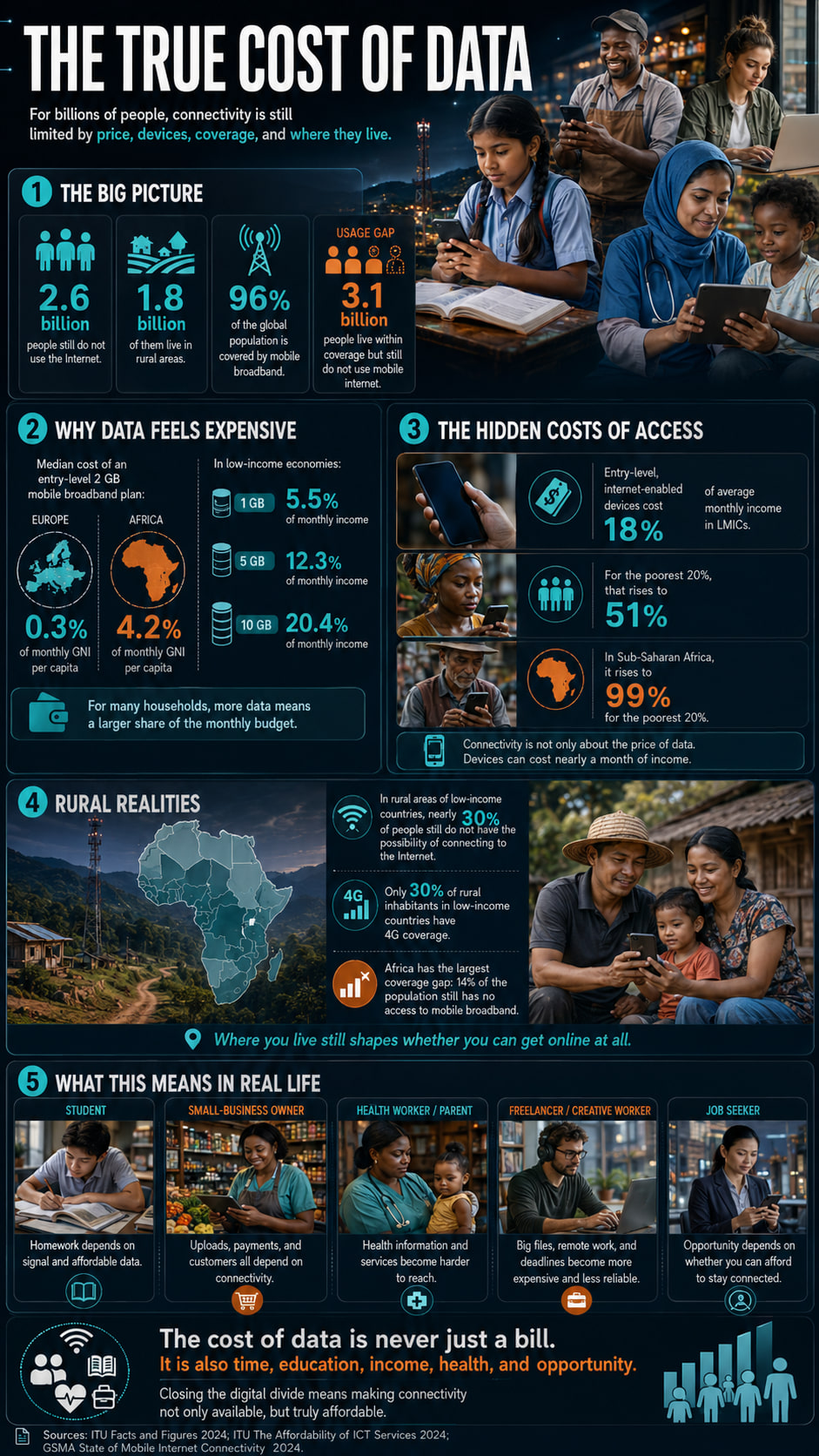
I build a tool that makes audio sessions smaller so they are cheaper and faster to send. To explain why that matters, I keep coming back to one fact that does not get said enough. For a huge share of the world, the cost of getting online is not a footnote. It is a real line in a tight monthly budget.
I spent a while reading the actual reports on this, the ones from the ITU and the GSMA, because I did not want to wave my hands at "the digital divide" and move on. The numbers are worse and more specific than the slogan. Here is what I found, and why I think anyone who ships files for a living should care.
The big picture
About 2.6 billion people still do not use the internet. Roughly 1.8 billion of them live in rural areas (ITU, Facts and Figures 2024).
The strange part is that coverage is not the main wall anymore. Around 96 percent of the global population lives under a mobile broadband signal. Yet about 3.1 billion people are inside that coverage and still do not use mobile internet (GSMA, State of Mobile Internet Connectivity 2024). The reports call that the usage gap. Read it again. Three billion people could connect on paper and do not, and it is mostly down to cost, devices, and know how, not towers.
That reframes the whole problem. We tend to picture the unconnected as people in places no signal reaches. Most of them are people the signal reaches who cannot afford to use it.
Why data feels expensive
The clearest way to see this is to look at the price of data as a share of income, not as a flat dollar figure. A dollar means something completely different depending on what you earn.
The United Nations set a target that an entry level data plan should cost no more than 2 percent of monthly income. Now look at reality. A 2 gigabyte entry level mobile broadband plan costs about 0.3 percent of monthly GNI per capita in Europe. The same kind of plan costs about 4.2 percent in Africa (ITU, The Affordability of ICT Services 2024).
It climbs fast with volume. In low income economies, mobile data runs around 5.5 percent of monthly income for 1 gigabyte, 12.3 percent for 5 gigabytes, and 20.4 percent for 10 gigabytes. For a lot of households, more data simply means a bigger bite out of the same fixed budget. Ten gigabytes, which is one large file in my world, can be a fifth of a month's income to move once.
The hidden costs of access
Price per gigabyte is only the part you see. There are two costs underneath it that people in well connected places rarely think about.
The first is the device. An entry level internet capable phone costs about 18 percent of average monthly income in low and middle income countries (ITU 2024). Connectivity is not only the price of data. The thing you connect with can cost nearly a month of income before you have bought a single gigabyte.
The second is who you are. Averages hide the people who get hit hardest. For the poorest 20 percent, that same 2 gigabyte plan rises to about 51 percent of income globally. In Sub Saharan Africa, for the poorest 20 percent, it reaches roughly 99 percent (ITU 2024). Almost a full month of income for two gigabytes. That is not a market that is slightly pricey. That is a door that is closed.
Rural realities
Where you live still decides whether you can get online at all. In rural areas of low income countries, nearly 30 percent of people do not have the possibility of connecting to the internet. Only about 30 percent of rural inhabitants in low income countries have 4G coverage. Africa carries the largest coverage gap, with around 14 percent of the population having no access to mobile broadband (ITU 2024).
So you have two different problems stacked on top of each other. In cities, the signal is there but the price is the wall. In the countryside, often the signal itself is not there. A person can be priced out, covered out, or both, and the result feels the same from the inside. The work does not move.
What this means in real life
It is easy to let these figures stay abstract. They are not abstract to the people living them.
For a student, homework depends on having a signal and affordable data. For a small business owner, uploads, payments, and customers all run through a connection that may or may not hold. For a health worker or a parent, information and services get harder to reach when the data runs out. For a freelancer or creative, big files, remote work, and deadlines all get more expensive and less reliable at once. For a job seeker, opportunity itself depends on whether you can afford to stay connected.
The cost of data is never just a bill. It is also time, education, income, health, and opportunity. Closing the divide is not only about making connectivity available. It is about making it genuinely affordable.
Where my little corner of this fits
I am not going to pretend a file compressor solves any of this. It does not build towers, it does not lower the price of a gigabyte, and it does not put a phone in anyone's hand. Those are jobs for policy, infrastructure, and people far more powerful than me.
What a smaller file does is narrow the gap between the connection someone has and the work they are trying to send across it. My tool, Crate, shrinks audio sessions typically 72 percent, up to 93 on the best material, completely lossless, and verifies every file with a SHA-256 checksum on both ends so nothing degrades on the way. If a session that cost a fifth of someone's monthly income to upload now costs a fraction of that, the math changes for the person paying it. That is the only honest claim I will make. It helps the work move on the connection people actually have, while the bigger problems get solved by bigger hands.
Frequently asked questions
How many people are still offline? About 2.6 billion, with roughly 1.8 billion of them in rural areas (ITU, Facts and Figures 2024).
If most people have coverage, why are they not online? About 3.1 billion live under a mobile broadband signal but still do not use it. The gap is mostly cost, device prices, and digital skills rather than missing coverage (GSMA 2024).
How expensive is mobile data compared to income? A 2 gigabyte plan is about 0.3 percent of monthly income in Europe and 4.2 percent in Africa. For the poorest 20 percent it can reach 51 percent globally and around 99 percent in Sub Saharan Africa (ITU 2024).
What is the affordability target? The UN Broadband Commission target is an entry level plan costing no more than 2 percent of monthly income.
What does this have to do with audio work? The files audio professionals send are large. On expensive or thin connections, the size of the file decides whether the work arrives on time and what it costs to send. Smaller files lower both.
The bill is the smallest part
When I look at all of this, the dollar figure on a data plan ends up being the least interesting number. The real cost is everything that does not happen because the data ran out. The homework, the payment, the diagnosis, the delivery, the chance.
I cannot fix that. I can make the thing I am responsible for, the file, small enough that it stops being one more wall. That is what I built, and that is all I will claim it does.
Sources: ITU, Facts and Figures 2024; ITU, The Affordability of ICT Services 2024; GSMA, State of Mobile Internet Connectivity 2024; UN Broadband Commission affordability target (2 percent of monthly income).