 CRATE
CRATE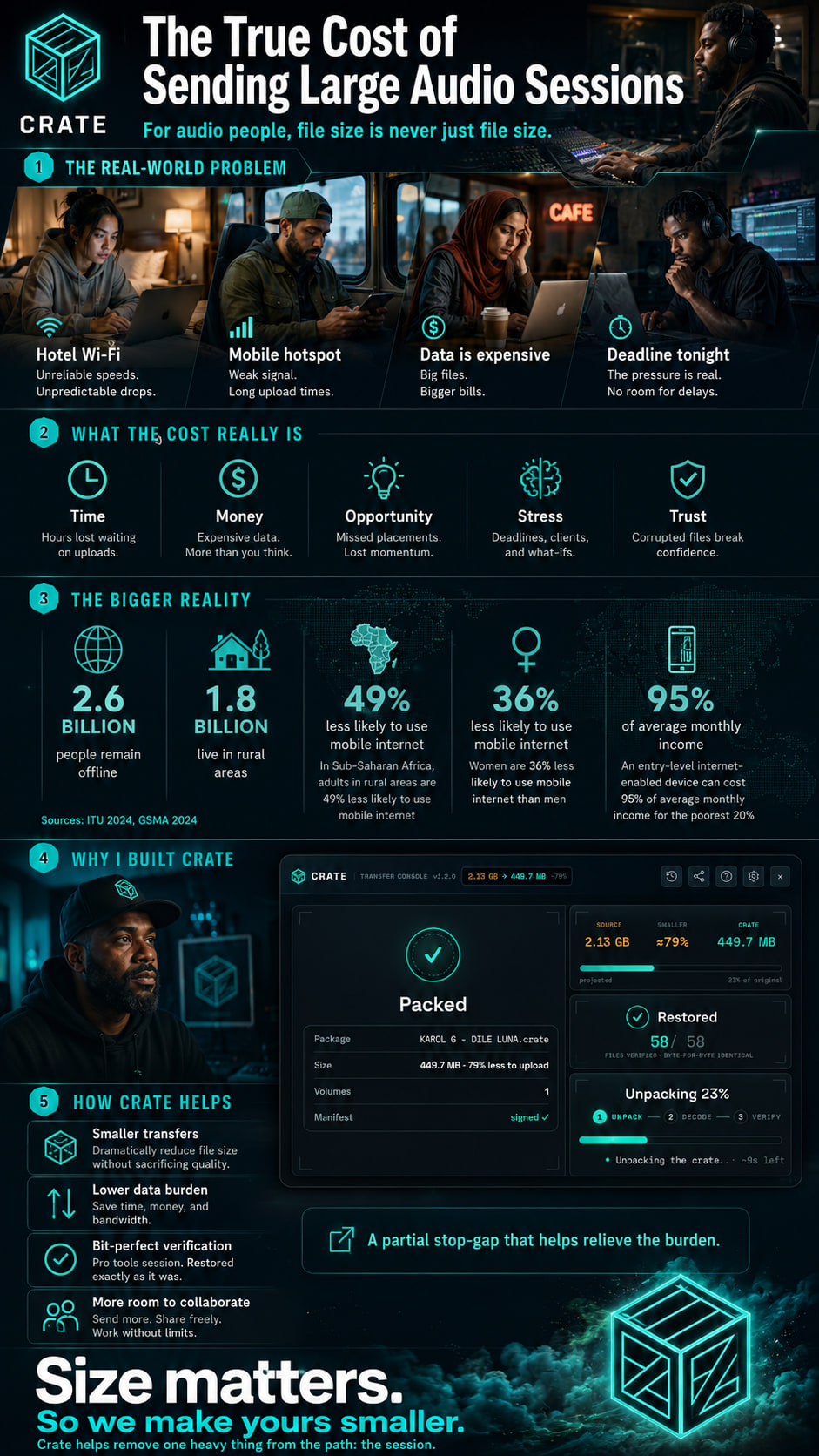
When people talk about sending large audio sessions, they usually talk about it like it's a minor inconvenience.
A progress bar. A slow upload. A frustrating wait.
But from where I sit, that framing is too shallow.
The true cost of sending large audio sessions is not just time.
It is also:
- missed deadlines
- extra data purchases
- broken confidence
- lower margins
- fewer revision cycles
- less creative flexibility
- more stress
- more unequal access to work
And if you do this work while traveling, freelancing, collaborating internationally, or operating anywhere with expensive data or unreliable internet, that cost stops being theoretical very quickly.
I care about this topic because I've lived versions of it.
I've been the person waiting on a bad connection.
I've been the person staring at a hotel upload.
I've been the person doing deadline math while the progress bar barely moves.
And I've become more and more convinced that audio people have been underserved by the basic file-transfer assumptions of the internet.
The normal workflow is more fragile than people admit
The default way many people send audio is still some variation of this:
- finish the session
- throw it in a ZIP
- upload it somewhere
- hope it gets there
- hope it opens
- fix it later if it doesn't
That workflow is "normal," but normal is not the same as good.
It hides the real costs because they show up as scattered annoyances instead of a single visible bill.
For example:
- if the upload fails, the cost is delay
- if the data is expensive, the cost is margin
- if the file is bloated, the cost is time and money
- if the session is corrupted or incomplete, the cost is trust
- if the connection is weak, the cost is opportunity
Individually, each one feels manageable.
Together, they shape who gets to move work efficiently and who doesn't.
The global picture is bigger than one engineer
This problem is not niche.
The International Telecommunication Union reported in 2024 that 2.6 billion people remain offline, and that 1.8 billion of them live in rural areas. The GSMA has also emphasized that a massive usage gap remains: billions of people live within coverage footprints but still do not use mobile internet, often because of affordability, device costs, skills, and other barriers.
That matters for audio because the modern music and post-production economy is global.
We collaborate across:
- countries
- time zones
- bandwidth realities
- infrastructure differences
- data pricing differences
The receiving engineer may be in a fully connected urban center. The producer may not be. A touring engineer may be on hotel Wi‑Fi. A freelancer may be on a hotspot. A collaborator may technically have coverage but still not have affordable, reliable access.
That gap changes the real cost of delivery.
Data is not equally cheap
One of the most important things people in well-connected environments forget is that "just upload it" is a luxury phrase.
For many people, data is not cheap enough to be invisible.
The ITU's affordability work has shown that the cost of mobile broadband still weighs much more heavily on lower-income populations, and GSMA research continues to identify affordability, both of data and internet-enabled devices, as one of the main barriers to mobile internet adoption.
That is not abstract. It hits creative work directly.
If sending a large session means:
- buying more mobile data
- rationing hotspot use
- waiting for access to better Wi‑Fi
- delaying a delivery until nighttime
- going somewhere else just to upload
then the cost is no longer "internet."
The cost becomes workflow friction.
And workflow friction compounds.
Weak internet changes how people work
When the connection is bad, you don't just work slower.
You work differently.
You make different decisions.
You may:
- send fewer revisions
- avoid full-resolution or full-session delivery
- delay collaboration
- over-compress with the wrong tools
- keep things local longer than you should
- miss windows where a project could move forward
That is what makes this such an important content theme for Crate.
It's not just a convenience story.
It's a creative throughput story.
The worse the connection, the more valuable it becomes to move less data without compromising the audio.
Rural and low-income realities make the problem sharper
GSMA's Sub-Saharan Africa research is especially clarifying here. It notes that Sub-Saharan Africa continues to have very large usage and coverage gaps, that adults in rural areas are much less likely to use mobile internet than urban adults, and that affordability remains the most significant barrier to adoption in many cases. The same research notes that in Sub-Saharan Africa an entry-level device can cost a very large share of average monthly income for the poorest 20%.
That should reset how we think about "just send the files."
If connectivity and devices are already expensive, then bloated session delivery becomes more than inefficiency. It becomes exclusionary.
Even when mobile broadband exists, the practical ability to use it meaningfully is not equal.
Why Crate exists in this bigger picture
This is one of the main reasons I built Crate.
Not because one app can fix the digital divide. It cannot. Crate cannot build towers, lower national data prices, change telecom policy, or make broadband universally affordable.
But it can deal with one specific burden audio people face every day:
the size of the work they have to move.
That matters more than it may seem from places where data is relatively cheap and reliable internet is assumed. In much of the world, sending a large session is not just annoying. It can mean buying extra data, choosing between opportunity and household needs, or spending money to send a track that may or may not turn into paid work.
That is a real barrier.
And it is not a barrier that audio professionals in wealthier, better-connected places usually feel with the same severity.
If a producer has to think, "Can I afford to send this session?" before they can even explore a collaboration, the playing field is not level. If every revision costs more data, every opportunity carries extra risk. If sending stems eats into the money someone needs for food, transport, or basic life expenses, then file size becomes more than a technical problem. It becomes an access problem.
Crate does not fix the system that makes data scarce, expensive, or unevenly distributed.
But it can give people a little more breathing room inside that system.
If a session can move at a fraction of the size, then the cost of trying goes down. The risk of sending goes down. The chance that the work actually reaches the next person goes up. That is not a complete solution, but it is meaningful.
For me, that is part of the mission.
Crate is a partial stop-gap for a broken system, but partial does not mean insignificant. Sometimes the most practical way to help is to remove one heavy thing from someone's path.
In this case, that heavy thing is the session.
The true cost for an audio engineer
Let me bring it back to the person in the chair.
If I'm an audio engineer, producer, editor, or collaborator, the real costs of a large session look like this:
1. Time cost
The obvious one.
Large uploads take longer. Failed uploads waste whole evenings. Weak connections force you to babysit transfers.
2. Money cost
If I am paying for mobile data, hotspots, coworking access, or backup internet, file size directly affects what the job costs me to complete.
3. Opportunity cost
If a transfer misses a deadline, a revision cycle gets pushed, a client waits longer, or a collaborator moves on without me.
4. Emotional cost
Bad transfer workflows are exhausting. They create low-grade anxiety around every handoff. You stop trusting the process.
5. Reputation cost
If I routinely send broken, bloated, or late deliveries, that affects how other people experience me professionally.
That is why I think the problem deserves a real page, not a feature bullet.
This is exactly where generic tools break down
Generic file-transfer logic assumes:
- the connection is good enough
- the sender can afford the wait
- the receiver can absorb the friction
- the archive format only needs to "open"
But audio workflows demand more than that.
We need:
- meaningful size reduction
- trust
- session integrity
- a clean way to hand off work across real-world internet conditions
That is why Crate's framing is strong.
It doesn't pretend to be magic.
It says something much more believable:
- audio deserves a tool built for audio
- smaller files move faster
- smaller transfers fail less often
- verified restores beat guesswork
That is the right level of ambition.
Why Crate is a partial stop-gap, not a fantasy solution
This is important, and I would say it plainly.
Crate is not broadband infrastructure.
Crate is not telecom reform.
Crate is not a substitute for affordable, universal connectivity.
But it is a meaningful partial stop-gap.
That phrase matters to me because it's honest.
Here's what Crate can do:
- make a session materially smaller
- lower the burden of upload and transfer
- reduce the chance that the file transfer itself becomes the bottleneck
- give the sender and receiver more confidence
- let people use whatever transfer method they already have
- make the workflow lighter in the real world
That is not everything.
But it is not nothing either.
And for many people, the difference between "too big to move comfortably" and "small enough to send tonight" is the difference that counts.
Final thought
If I had to sum up the whole issue in one sentence, it would be this:
The cost of a large audio session is never just the size of the folder.
It is the delay.
The budget strain.
The retry.
The weak signal.
The missed window.
The anxiety.
The client waiting.
The creative momentum draining away while the progress bar crawls.
That is the real cost.
And that is also why Crate matters.
Not because it fixes the whole world.
But because it removes one painful, unnecessary part of it.
That is worth building for.
And that is worth explaining clearly.