 CRATE
CRATE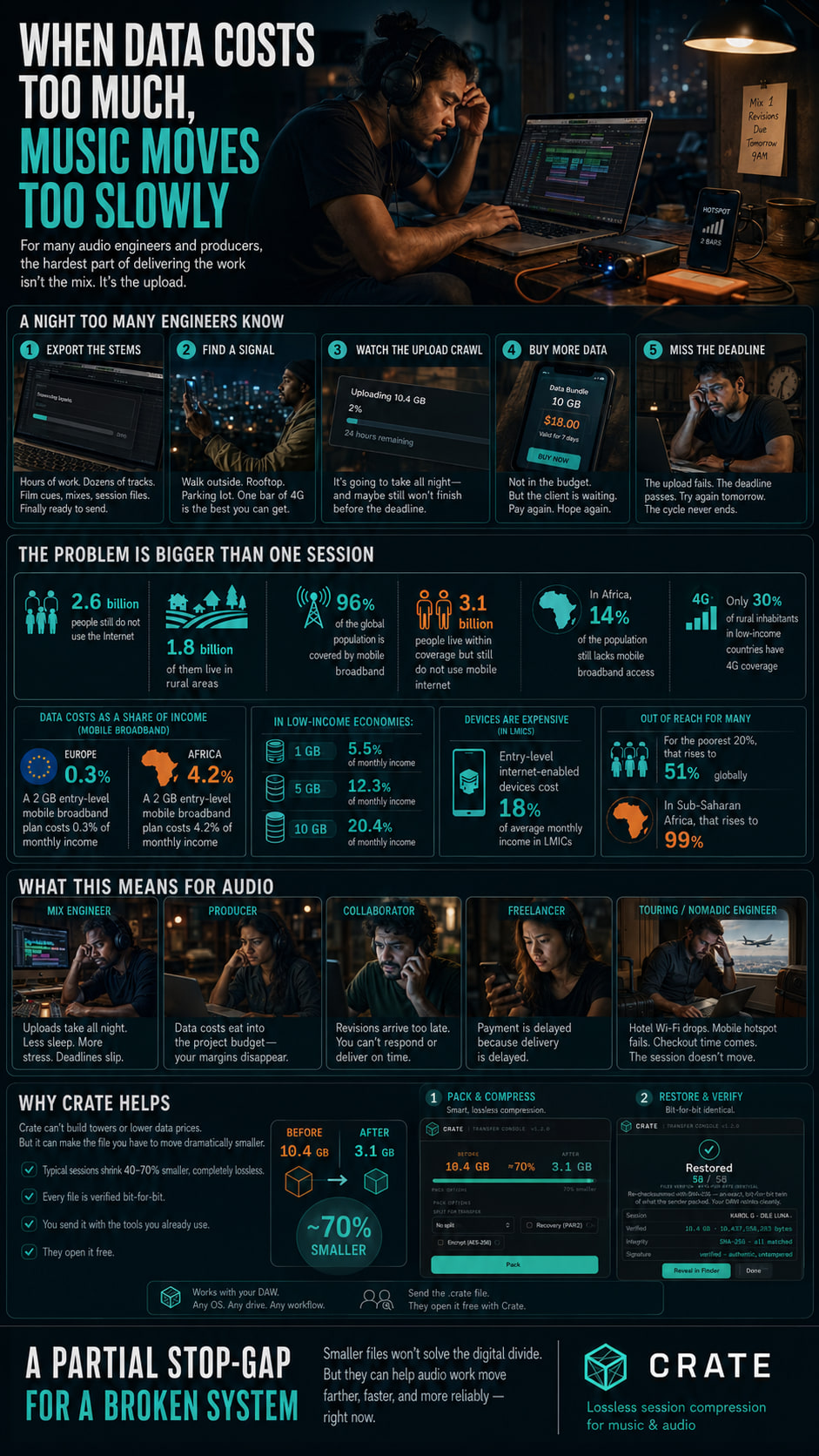
I have watched a finished mix sit on a hard drive for two days because the upload would not go through. Not the mix being wrong. The mix was done. The work was good. The internet was the problem.
If you make music for a living, you already know the feeling. You pour a week into a session, you bounce the stems, and then you hit the part nobody warns you about at the start. You have to move the file. And the file is enormous, and the connection is not.
I want to talk about why that happens, because it is bigger than a slow night here and there. It is a structural thing that touches a few billion people. And I want to be honest about what a small tool can and cannot do about it.
The night a lot of us know
Here is the shape of it. You export the stems. Hours of work, dozens of tracks, film cues, alternate mixes, the whole session folder. You are finally ready to send.
Then you go looking for a signal. Outside, the rooftop, the parking lot. One bar of 4G is the best you can find. You start the upload and watch it crawl. Ten gigabytes at two percent, twenty four hours remaining, and maybe it still will not finish before the deadline.
So you buy more data. It was not in the budget, but the client is waiting, so you pay again and hope again. And sometimes the upload fails anyway. The deadline passes. You try again tomorrow. The cycle does not really end, it just waits for the next session.
I have lived versions of that night, and I have heard the same story from engineers in Lagos, mixers in Manila, producers working off a hotspot on a mountain road outside Medellin. Same wall every time. The work is ready. The bandwidth is not.
This is not a personal failing, it is a map
It would be easy to treat this as a "you need better internet" problem and move on. The numbers say otherwise.
About 2.6 billion people still do not use the internet at all, and roughly 1.8 billion of them live in rural areas (ITU, Facts and Figures 2024). That is not a rounding error. That is close to a third of the planet.
Coverage is not even the main issue anymore. Around 96 percent of the global population is covered by a mobile broadband signal, yet about 3.1 billion people live inside that coverage and still do not use mobile internet (GSMA, State of Mobile Internet Connectivity 2024). The industry calls that the usage gap, and it is mostly about cost, devices, and skills, not towers.
Where towers are the issue, it is brutal. Only about 30 percent of rural inhabitants in low income countries have 4G coverage, and in Africa roughly 14 percent of the population still has no mobile broadband access at all (ITU 2024). If you happen to be working from one of those places, the session does not move, full stop.
The real cost is not the bill, it is the share
Price is where this gets personal, and where I think most people in well connected cities lose the plot.
The United Nations Broadband Commission set an affordability target of an entry level data plan costing no more than 2 percent of monthly income. Hold that number.
A 2 gigabyte entry level mobile broadband plan costs about 0.3 percent of monthly income in Europe. The same kind of plan costs about 4.2 percent of monthly income in Africa (ITU, The Affordability of ICT Services 2024). Same two gigabytes. Wildly different weight.
It gets heavier as you need more. In low income economies, the median cost of mobile data runs around 5.5 percent of monthly income for 1 gigabyte, 12.3 percent for 5 gigabytes, and 20.4 percent for 10 gigabytes. A single ten gigabyte session, the kind any of us bounce without thinking, can cost a fifth of someone's monthly income to move one time.
And that is before you own a device. An entry level internet capable phone costs around 18 percent of average monthly income in low and middle income countries. For the poorest 20 percent of people, that 2 gigabyte plan rises to about 51 percent of their income globally, and in Sub Saharan Africa it reaches roughly 99 percent (ITU 2024). Nearly a full month of income for two gigabytes.
So when an engineer in one of those places tells you the upload is the hard part, they are not being dramatic. The data costs real money, sometimes a day's food, and the session does not care.
What this actually does to audio work
Translate those numbers into the people I build for and it gets specific fast.
The mix engineer uploads all night, sleeps less, and watches deadlines slip. The producer watches data costs eat into a project budget until the margin is gone. The collaborator gets revisions too late to respond or deliver on time. The freelancer waits on a payment that is stuck behind a delivery that will not go through. The touring or nomadic engineer loses the hotel Wi-Fi, the mobile hotspot fails, checkout time comes, and the session still has not moved.
None of these are quality problems. The work is finished. The bottleneck is the pipe.
What I built, and what it really is
I make a tool called Crate. It is a lossless compression and transfer app for music and audio. It does one job. It makes the file you have to move dramatically smaller, without changing a single sample.
A typical session shrinks 72 percent smaller, and up to 93 on the right material, completely lossless. Not "transparent," not "good enough." Bit for bit identical. Crate runs a SHA-256 checksum over every file when it packs, and again when the recipient opens it, so both ends can prove the audio is exactly what you sent. No quality lost, no silent corruption, no "re-send that stem, it came through with a click."
It is a tool, not a platform. There is no account, no subscription, and it works offline. You pack a session straight from your right click menu or the menu bar, then you send the smaller file over whatever you already use, WeTransfer, Drive, a USB drive, email. Receiving is always free. Anyone, anywhere can open what you send without paying me a cent. The first pack is free, and unlimited packing is a one time 25 dollars.
The math is the whole point. A 10.4 gigabyte upload becomes about 3.1 gigabytes. On a plan that charges by the gigabyte, that is not a convenience, that is rent money. On a deadline, the smaller file is the difference between making it and not.
I am going to be honest about the limits
I am not going to pretend a compression tool fixes the digital divide. It does not. Crate cannot build a cell tower, lower the price of a gigabyte, or put an affordable phone in someone's hand. Those are policy and infrastructure problems, and they are far above my pay grade.
What a smaller file can do is help the work move farther, faster, and more reliably on the connection a person actually has today, not the one they wish they had. It is a partial stop-gap for a broken system. I would rather say that plainly than oversell it.
That honesty is part of why I built it the way I did. People are handing me their masters. The least I can do is be exact about what is happening to their audio and clear about what the tool is for.
Frequently asked questions
Does compressing a session hurt the audio quality? No. Crate uses lossless compression, which means the decoded audio is identical to the original, sample for sample. It verifies that with a SHA-256 checksum on both ends, so you can prove it rather than trust it.
How much smaller do sessions actually get? Typically 72 percent smaller, depending on the material, and up to 93 on the best of it. Sessions heavy on recorded audio and repeated takes compress the most.
Do the people I send to have to pay or sign up? No. Receiving and opening a Crate file is always free, with no account. Only packing your own sessions needs a one time payment.
Will this fix bad internet? It will not. It makes the file you have to move smaller, which helps on slow or expensive connections, but it cannot change coverage or data prices.
Why does data cost so much in some places? A mix of thin rural coverage, expensive devices, and prices that take a large share of low monthly incomes. A 2 gigabyte plan that is 0.3 percent of income in Europe can be 4.2 percent in Africa, and far higher for the poorest households (ITU 2024).
The work is ready. Let the file catch up.
If you have ever sat in a parking lot at 1 a.m. watching an upload bar refuse to move, this is for you. The mix was never the slow part. The internet was. I cannot fix the internet. I can make your session small enough to slip through the one you are stuck with.
Pack once. Send anywhere. Your first pack is on me.
Sources: ITU, Facts and Figures 2024; ITU, The Affordability of ICT Services 2024; GSMA, State of Mobile Internet Connectivity 2024; UN Broadband Commission affordability target (2 percent of monthly income).