 CRATE
CRATE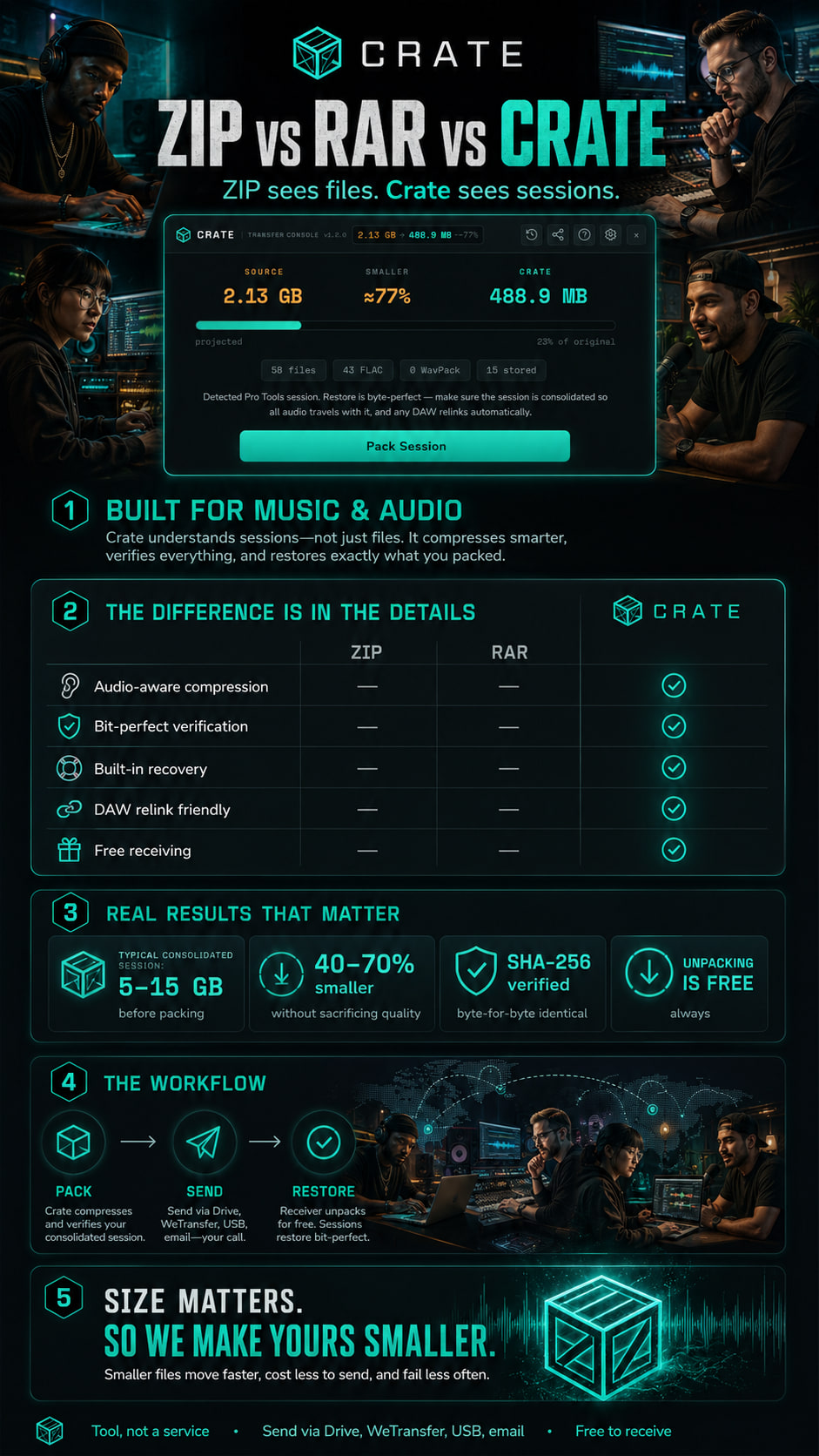
I'm not against ZIP.
I'm not against RAR either.
Both tools have been useful for a very long time, and for a lot of normal files, they still are. If I'm sending documents, screenshots, contracts, or a folder of random assets, I don't need to overthink it. ZIP is everywhere. RAR has been around forever. 7-Zip has its place too.
But audio sessions are not normal files.
That is the whole point.
When I'm sending a Pro Tools session, a folder of stems, a multitrack archive, or a handoff to a mix engineer, I'm not moving "stuff." I'm moving a workflow. I'm moving a project that has timing relationships, file dependencies, relinks, revision pressure, and deadlines. I'm moving something that has to open properly on the other side or somebody loses time, money, patience, or trust.
That is why I think the wrong question is:
"Which archive tool is the most famous?"
The better question is:
"Which tool is best for audio?"
And for that question, I think it helps to compare ZIP, RAR, and Crate honestly.
First: what most archive tools actually do
Traditional archive tools were built to treat files as generic data.
That's not a flaw. That's simply their job.
A WAV file, a PDF, a spreadsheet, a folder of photos, or a text file all come into the same general system. The tool's job is to bundle, compress what it can, and make the package easier to move or store.
That works fine for general computing.
But audio workflows expose the limits very quickly.
A modern session often contains:
- long stretches of silence
- repeated loops
- duplicated bus prints
- alternate versions
- consolidated tracks
- session backups
- a DAW project file that has to reconnect to media correctly
- audio that may be large even when the musical content is sparse
A generic archive utility doesn't understand any of that in a workflow sense. It just sees bytes.
That's where the difference begins.
ZIP: convenient, familiar, and usually not enough
The reason people still default to ZIP is obvious: it's built into a lot of systems, people know what it is, and nobody has to learn a new term.
That convenience matters.
But in audio, convenience is not the same as adequacy.
A ZIP file may be fine when the session is already small, the internet is fast, and nobody is stressed. The problem is that those are exactly the conditions where almost anything works.
I don't build my workflow around the easy day.
I build it around:
- hotel Wi-Fi
- a coffee shop connection that collapses halfway through
- a producer on a hotspot
- a mixer waiting in another time zone
- an upload deadline before checkout
- a session that is too big for the connection I'm on
That is where ZIP starts to feel blunt.
It doesn't know audio. It doesn't know stems. It doesn't know relinking. It doesn't know that shaving a meaningful amount off an audio package can be the difference between "sent tonight" and "missed again."
So while ZIP is simple, I don't think simplicity alone is enough reason to trust it with serious audio handoff work.
RAR: better compression, but still not built for the workflow
RAR usually enters the conversation when someone says, "ZIP didn't save enough space."
That's fair.
RAR is often the "power user" answer. People like it because it has a reputation for stronger compression and more advanced archive features than basic ZIP workflows.
And compared with ZIP, that can absolutely matter.
But my issue with RAR has never been that it is bad.
My issue is that it still isn't built around the actual job I'm trying to do.
The job is not:
- "make one general-purpose archive"
The job is:
- "move an audio session reliably"
- "restore it correctly"
- "verify that nothing went wrong"
- "keep the session usable"
- "remove guesswork for the receiver"
That's a different brief.
Even if RAR compresses better than ZIP in some cases, it still doesn't solve the broader audio delivery problem by itself. It doesn't turn a generic archive into an audio-native workflow.
And that distinction matters more than people think.
The real issue is not archive format. It's workflow confidence.
In my experience, audio delivery problems usually come from one of five places:
- The files are too big
- The connection is too weak
- The session is messy
- The sender includes the wrong things
- The receiver doesn't fully trust what arrived
Generic archive tools really only address the first problem, and even then, not specifically for audio.
They don't solve:
- messy session prep
- confidence in restore
- the psychological cost of "I hope it's fine"
- the fact that one missing file can break the handoff
- the need to prove that what arrived is what was sent
That is why I believe a comparison page shouldn't just compare compression.
It should compare outcomes.
Where Crate is different
Crate was built for one category of pain: moving audio.
Not documents. Not photos. Not everything.
Audio.
That sounds narrower, but it's actually the whole advantage.
Because once you start from that premise, the design priorities change.
Instead of asking:
- "How do we make a general archive?"
You ask:
- "How do we make audio smaller?"
- "How do we verify it bit for bit?"
- "How do we make receiving free?"
- "How do we let people send it any way they already send files?"
- "How do we help DAWs land cleanly on the other side?"
That is the frame I wish existed years earlier.
Crate is not trying to become a cloud platform or force everybody into a new ecosystem. I like that. It behaves like a tool, not a service. Pack the session. Send the .crate file using whatever you already use. Let the other person open it free. Restore it. Verify it. Keep moving.
That's a very different user promise than "here is a generic compressed folder."
Why that matters specifically for audio
Here is the simplest way I can say it:
ZIP sees files. Crate sees sessions.
That difference ripples outward.
When I'm sending audio, I care about:
- size reduction that is meaningful, not trivial
- preservation of the exact audio
- a clean restore
- confidence that the package is intact
- lower friction for the person receiving it
- a workflow that respects how audio people actually work
That is why a purpose-built tool wins.
Not because generic tools are useless.
But because purpose-built tools are better when the workflow actually matters.
What I'd recommend in plain English
If you're sending:
- contracts
- notes
- artwork
- miscellaneous folders
- casual assets
Use whatever you like.
But if you're sending:
- Pro Tools sessions
- stems
- multitracks
- consolidated session folders
- delivery packages to a mix engineer
- anything large, deadline-sensitive, or mission-critical
I would use a tool built for audio.
That is the dividing line.
My practical recommendation
Here's how I think about it now:
Use ZIP when:
- the files are small
- nobody is under pressure
- you just need a universal basic archive
Use RAR when:
- you want a more advanced general archive
- the other side is comfortable with it
- you're still operating in a generic file-compression workflow
Use Crate when:
- you're moving real audio work
- size actually matters
- the connection is weak
- the consequences of failure are real
- you want a workflow designed around sessions, not generic files
That's really it.
The bigger idea
The more I think about it, the less this is really a "ZIP vs RAR" conversation.
It's a category conversation.
It's the difference between:
- using something that can archive audio
- and using something built for audio delivery
That's a much bigger shift.
I think a lot of us accepted the wrong baseline for years because it was normal. We normalized big uploads, shaky handoffs, bad hotel Wi-Fi, relink anxiety, and long waits because the tools we had were "good enough."
But "good enough" is usually another way of saying:
- we got used to unnecessary friction
Crate is interesting to me because it challenges that assumption.
It says:
- maybe audio deserves its own archive logic
- maybe receiving should be free
- maybe verification should be built in
- maybe moving a session should feel less fragile
- maybe the archive should understand the category it serves
I agree with that.
Final thought
If you only remember one thing from this page, I'd want it to be this:
The right comparison is not just which archive opens.
It's which workflow survives.
That's the standard I care about.
Because when a handoff really matters, I'm not looking for the most famous file format.
I'm looking for the least risky way to move the work.
And for audio, I think that's exactly where Crate belongs.